Seeing flashing lights and orange cones stretched across the road ahead is enough to make anyone’s heart race — even if you have had nothing to drink. DUI checkpoints, officially called sobriety checkpoints or OVI checkpoints in Ohio, are a regular part of law enforcement’s effort to reduce impaired driving. But that does not mean officers have unlimited power at these stops, and it certainly does not mean you are without rights.
Whether you are reading this before you ever encounter a checkpoint or in the hours after an arrest, this guide will walk you through exactly what Ohio law says, what you can expect at an OVI checkpoint, and what steps to take to protect yourself. Our Dayton DUI/OVI defense attorneys at Gounaris Abboud are available around the clock to help.
Are DUI Checkpoints Legal in Ohio?
Yes — but with important limitations. Sobriety checkpoints were challenged as unconstitutional early on, with critics arguing they violated Fourth Amendment protections against unreasonable searches and seizures. The U.S. Supreme Court addressed this directly in Michigan Dept. of State Police vs. Sitz,, ruling that checkpoints are constitutional provided they meet specific procedural requirements.
Those requirements include operating the checkpoint without any form of racial or other discriminatory profiling, stopping vehicles in a systematic and neutral pattern (such as every third car), providing advance public notice of the checkpoint’s location and timing, and ensuring the checkpoint is supervised by senior law enforcement officials rather than left to the discretion of individual officers.
If any of these requirements are not met, the checkpoint itself may be challenged — and evidence gathered at an unconstitutional checkpoint may be suppressed. This is one of the most powerful tools an experienced OVI defense attorney can use on your behalf.
How to Find Out About Upcoming Ohio OVI Checkpoints
Ohio law enforcement agencies, including the Ohio State Patrol , are generally required to announce sobriety checkpoints in advance. These announcements are typically published through local media, social media channels, and official agency websites.
The announcement will usually include the general location, date, and time window of the checkpoint.
Checkpoints are most common during holiday weekends, major sporting events, and late-night weekend hours when impaired driving rates are statistically higher. Knowing about a checkpoint in advance gives you the opportunity to plan an alternate route if you choose — which is entirely legal.
Facing OVI or Other Charges Post-DUI Checkpoint?
Contact Us
Call 937-222-1515 for a free consultation and case review with top Dayton DUI lawyers at Gounaris Abboud.
How to Identify an OVI Checkpoint
Law enforcement makes checkpoints deliberately visible to approaching drivers. You will typically see reflective cones, traffic delineators, flares, and spotlights marking the checkpoint boundaries. Officers in uniform are usually stationed at the entry point, and marked patrol vehicles are visible throughout the area.
Once you can clearly see a checkpoint ahead and have not yet entered the designated checkpoint zone, you are legally permitted to turn around and take a different route — provided you do so safely and obey all traffic laws. However, once you have crossed into the checkpoint area, you are legally required to proceed through it.
What to Expect During an Ohio OVI Checkpoint
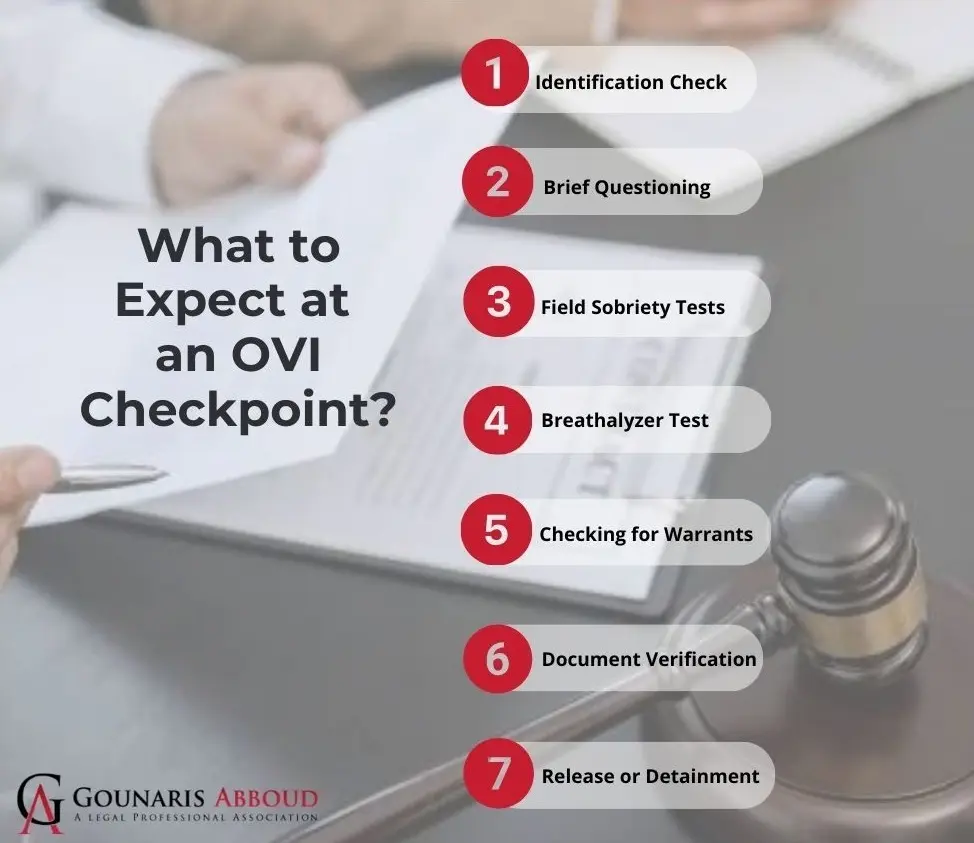
Most checkpoints follow a predictable sequence. Understanding what is coming can help you stay calm and composed, which matters more than most people realize.
- Document check. The first thing an officer will ask for is your driver’s license, vehicle registration, and proof of insurance. You are legally required to provide these documents. Have them accessible before you reach the checkpoint to avoid fumbling.
- Brief questioning. Officers may ask where you are coming from, where you are headed, and whether you have consumed any alcohol. You have the right to remain silent under the Fifth Amendment. You are not required to answer these questions. A polite, calm “I prefer not to answer questions without an attorney present” is a legally protected response.
- Field sobriety test. If an officer suspects impairment based on your appearance, speech, or behavior, they may ask you to step out of the vehicle and perform a standardized field sobriety test. These tests are voluntary — you have the right to decline. Many experienced OVI attorneys actually recommend declining, because the tests are highly subjective and even sober people can fail them due to nervousness, physical conditions, or environmental factors.
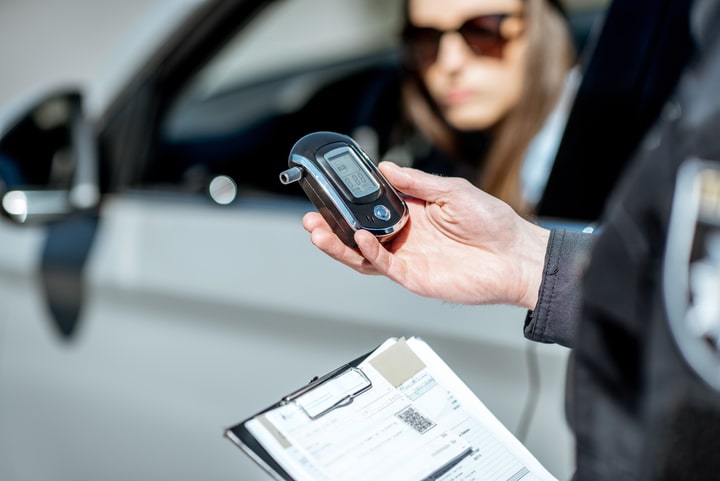
- Breathalyzer test. If the officer has reason to believe you are impaired after the field sobriety test (or if you declined it), they may request a breathalyzer test. Under Ohio’s implied consent law, refusing a breathalyzer triggers an automatic administrative license suspension. However, the refusal itself can also be challenged. If you have refused a test, contact our attorneys immediately — our guide on what happens if you fail a breathalyzer explains the consequences in detail.
- Warrant check and release or arrest. Officers will run your information for outstanding warrants. If no evidence of impairment is found, you will be released. If the officer has probable cause to believe you are impaired, you will be detained and likely arrested for OVI.
Your Rights at an Ohio OVI Checkpoint
It is easy to feel like you have no power at a checkpoint, but the law gives you meaningful protections.
- The right to remain silent: The Fifth Amendment applies at checkpoints. You must provide your documents, but you are not required to answer questions about your activities or alcohol consumption.
- Fourth Amendment protections: Officers cannot search your vehicle at a checkpoint without a warrant or a recognized exception, such as plain view of contraband or a search incident to a lawful arrest. Simply being stopped does not authorize a search.
- The right to refuse field sobriety tests: These tests are voluntary. Declining them cannot be used as evidence of impairment, though officers may still proceed with an arrest based on other observations.
- The right to legal representation: If you are arrested at a checkpoint, you have the right to an attorney. Invoke this right immediately and do not answer further questions until you have spoken with counsel.
- The right to record the encounter: In Ohio, you have the right to record your interaction with law enforcement at a checkpoint, provided you do not interfere with officers performing their duties.
What to Do If You Are Arrested at an OVI Checkpoint
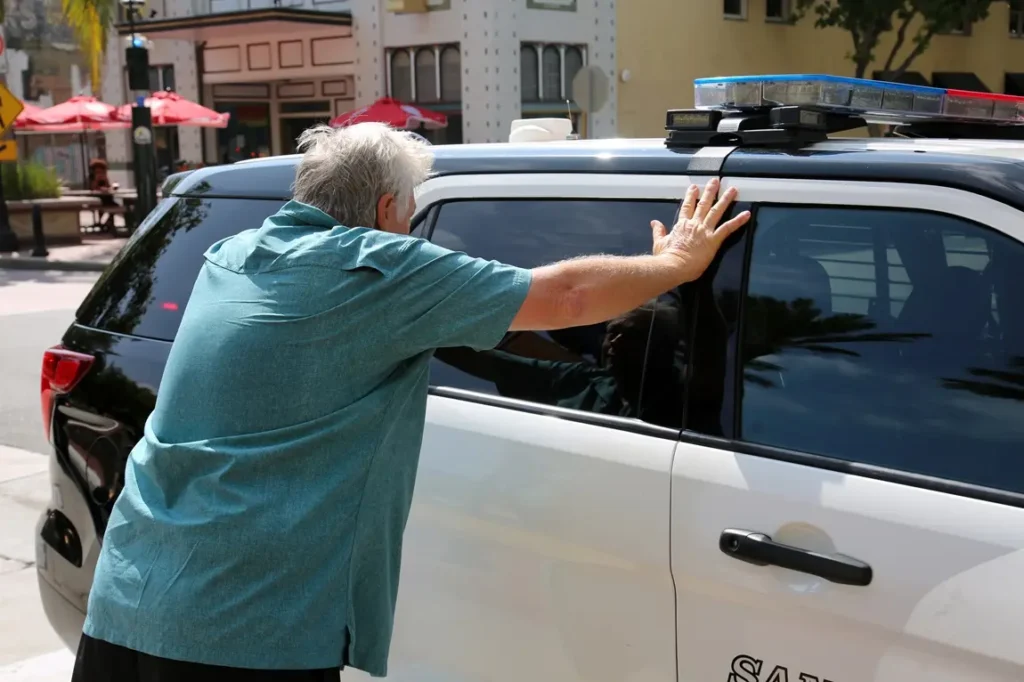
Being arrested at a checkpoint does not mean you will be convicted. Here is what to do immediately:
Stay calm and do not argue with officers at the scene. Invoke your right to remain silent and your right to an attorney. Do not consent to any searches. Contact an experienced Dayton OVI defense attorney as soon as possible — ideally within hours of your arrest, as certain deadlines for challenging your license suspension are very short.
Your attorney will examine whether the checkpoint was conducted lawfully, whether your rights were violated during the stop, whether the field sobriety tests were properly administered, and whether the breathalyzer equipment was properly calibrated and operated. Any of these issues could result in evidence being suppressed or charges being reduced or dismissed.
Can You Challenge a DUI Checkpoint Arrest?

Absolutely. Checkpoint arrests are actually among the most defensible OVI cases because there are so many procedural requirements that must be met. If officers deviated from the required neutral stopping pattern, if the checkpoint was not properly announced, if your Fourth or Fifth Amendment rights were violated, or if the breathalyzer test was improperly administered, your attorney may be able to challenge the evidence against you.
Our firm has a strong track record of achieving favorable outcomes in OVI cases, including cases that began at checkpoints. You can review our case results to see examples of how we have helped clients in similar situations.
If you are also concerned about a possible second OVI offense or third OVI offense, the stakes are even higher — and the need for experienced legal representation is even more urgent.
Facing DUI Charges? Don’t Navigate It Alone!
Contact Us
Let the OVI/DUI defense attorneys at Gounaris Abboud defend you against your charges. Call today for a free consultation.
What About Driving While High at a Checkpoint?
OVI charges are not limited to alcohol. Ohio law also prohibits operating a vehicle while impaired by drugs, including marijuana, prescription medications, and illegal substances. If you are stopped at a checkpoint and an officer suspects drug impairment, they may request a blood or urine test. Our guide on driving while high in Ohio explains how drug OVI charges work and what defenses may be available. If you were charged with an OVI involving prescription drugs, the legal analysis is different and requires specific expertise. You may also find our FAQ on how to pass a breathalyzer test and our guide on whether you can get a DUI for prescription drugs helpful for understanding the full scope of Ohio’s OVI laws.
Discover Our Latest Case: Recent Case: OVI Charge in Dayton, Ohio
The University of Dayton Student Charged with OVI
Failed Field Sobriety Test
THE FACTS: Our Client was a student at the University of Dayton and was traveling on Evanston Avenue on campus. Police indicate that our client was pulled over after they went through a stop sign. Our client was able to properly provide a valid driver’s license, registration, and proof of insurance. Police claim a strong odor of alcohol came from our client, and that our client had slurred speech and glassy and bloodshot eyes. As a result, our client was removed from the car and completed a field sobriety test.
The officer claimed that our client performed poorly on the standardized field sobriety tests and arrested our client, charging an OVI. At the police station, our client completed a chemical breath test, which indicated a blood-alcohol level of .208. Despite this being the first time our client had ever been arrested, and because of the “high tier” test, our client was facing six (6) days in jail (with 3 mandatory days in jail and 3 days in a treatment program) along with other sanctions including a mandatory drivers license suspension of between 1 to 3 years.
THE DEFENSE: The lawyers at Gounaris Abboud immediately secured an order from the Court to preserve the video evidence of the stop utilized that evidence and filed a Motion to Suppress the evidence. A hearing was held and we were able to prove to the Court that our client did NOT have slurred speech. We proved that our client was able to answer all questions appropriately and finally, we were able to prove that our client was able to properly perform the field sobriety tests.
THE RESULT: The Judge agreed with our argument and as a result, the most serious charges were dismissed and our client paid a fine and court costs.
Contact Our Dayton OVI Lawyers Today
A checkpoint arrest can feel overwhelming, but it is not the end of the road. The attorneys at Gounaris Abboud, LPA have spent decades defending OVI charges in Dayton and throughout Ohio. We know how to scrutinize every detail of a checkpoint stop — from the legality of the checkpoint itself to the accuracy of the testing equipment — and we fight hard to protect your license, your record, and your future.
We are available 24 hours a day, seven days a week, and your initial consultation is completely free. Contact us today to speak with an experienced Dayton OVI attorney about your case.